
The challenge.
Design a product and system that solves global issues;
depleted nutrients in agricultural soils, littering on land and below water, [and through a symbiotic alliance with farming] improves human health.
The solution.
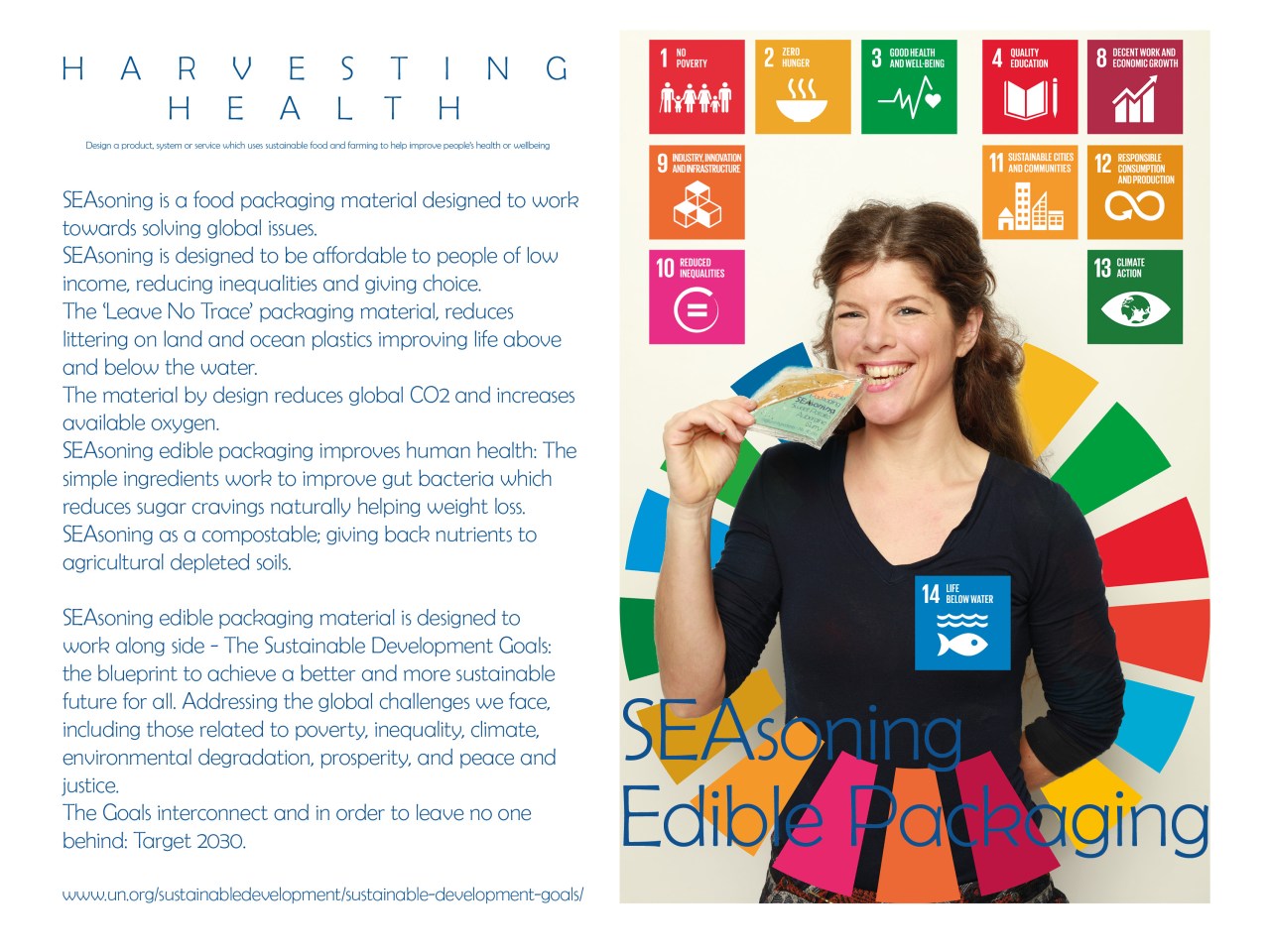
SEAsoning; Leave no trace food packaging material developed for solving global issues.
-
- Liquid polmer
-

- Dryed into a flat suface material
-
- Transparent – products can be seen
The ingredients, potato starch and seaweed makes the ‘Leave No Trace’ transparent material. I chose these materials for their added value.
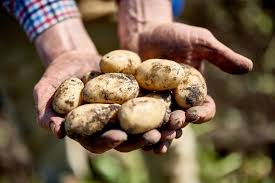 Starch from potatoes, because the potato peel is the second most wasted food globally.
The waste peel from potatoes used to manufacture and make, crisps, chips, ready meals and other fast-convenience foods are often discarded and sent to landfill.
Media coverage often mentions the worrying amounts of food that is thrown away -45 % of the food that is produced.
The humanitarian among us worry about the people in our world going hungry. A hidden issue caused, affecting us all, rich and poor is the released methane gas, adding to greenhouse gases and a major contribution to global warming. Repurposing wasted food like potatoes reduces the methane gas that is released into the ozone.
Read IAM Fuel blog – For a system that capitalise on gases for energy.
It’s not all bad news though… potato starch a resistant starch found in the peel, if eaten slows the absorption of refined sugars, it balances insulin levels reducing sugar craving, the starch also has a positive effect on the good gut bacteria, further reducing sugar craving and promoting good mental health. (Gunnars, K., 2019)
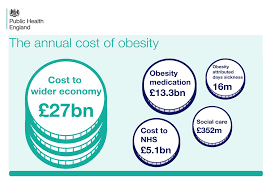
I’m sure I don’t have to spell out the obvious maths, improving human health reduces the NHS bill caused by diabetes and obesity. A whopping 16 bn a year in the U.K.
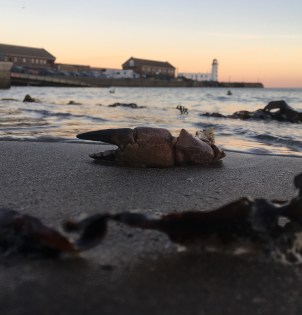
Image : Me – Scarborough bay
I haven’t even started discussing the positive global effects of farming seaweed responsibly… This next bit is genius.
Seaweed is definitely a resource to get giddy about when I explored farming responsibly.
The superfood plant cleanses water of chemicals that surrounds it, metabolizes greenhouse gases and breaths out oxygen.
Seaweed grows abundantly throughout the world’s oceans and therefore reduces CO2 issues caused by transportation. …………………………………………………………………….(greener idealGreener Ideal. 2012)…………………….

Image credit: Dixie D. Vereen, The Washington Post
I called seaweed superfood because that’s the description, given by a growing number of foodies, hippies and nutritionists.
Image, Moorish Stew by chef Barton Seaver, where he has replaced the wilted spinach in a traditional Spanish recipe with seaweed.
The non-mineral oil polymer is edible and designed to taste great, hence the name SEAsoning. SEAsoning edible polymer naturally preserves vegetables and fruit, thanks to the naturally occurring preserving enzymes in seaweed, also the natural gas barrier that the polymer provides, ticking an essential box of food packaging which is to protect, reducing food waste.


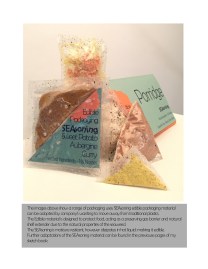
In the U.K seaweed is known as a poor person’s vegetable, historically associated with deprived coastal villages. This was the catalised for partnering one of the origanal supper foods with the company Wonky Veg boxes.co.uk

SEAsoning product was developed to sit alongside ‘Wonky Veg’ a delivered to the door vege box system, affordable to people of low-income, reducing inequalities and giving choice.
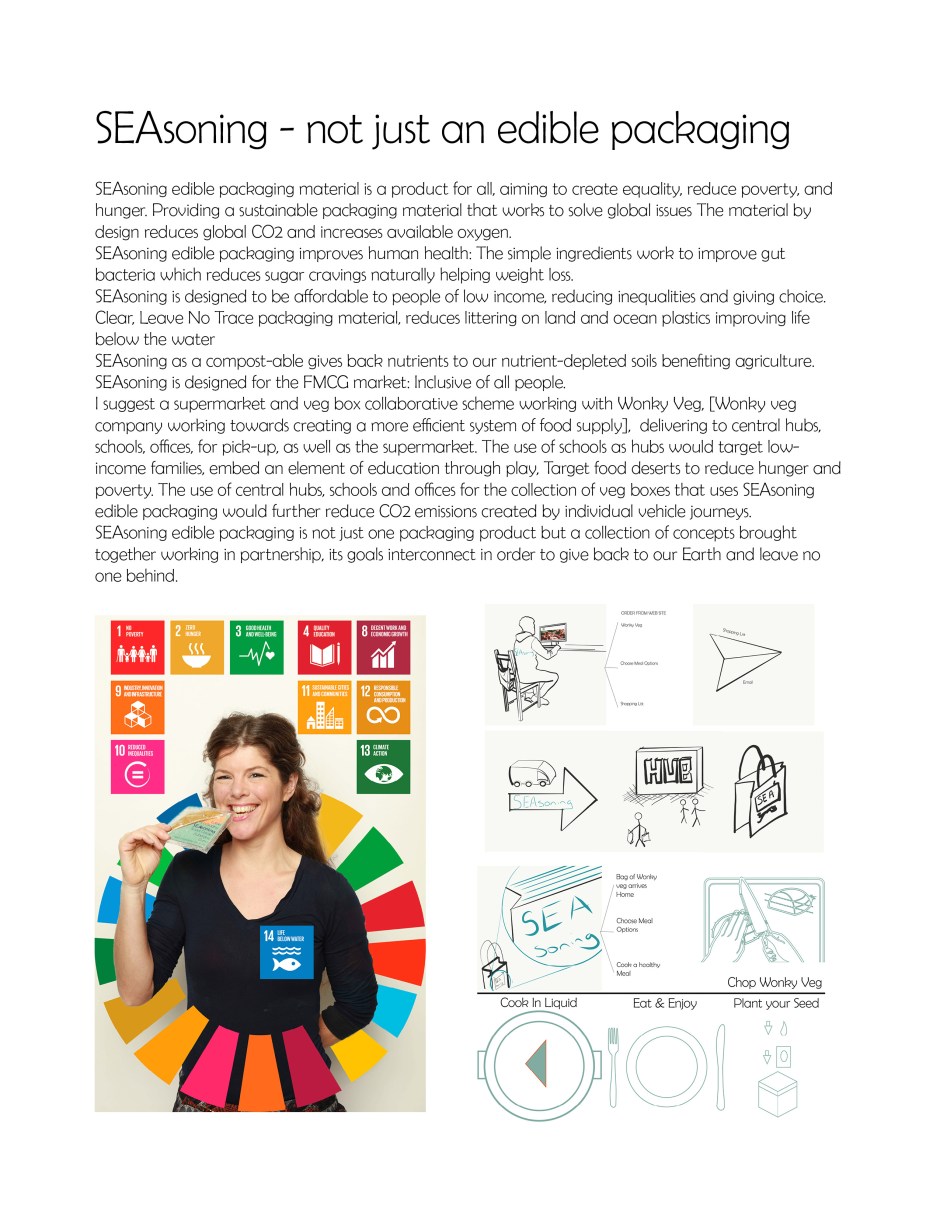
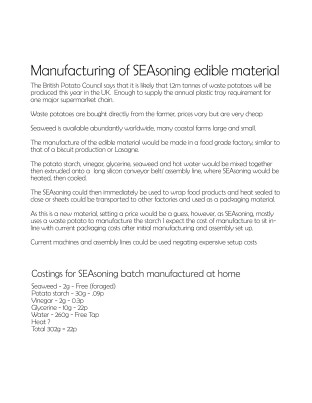
The SEAsoning material and products were developed and designed for mass FMCG marketplace. My intention for the material is to be blow-moulded into shape, like current plastics on the assembly line, or to be made into flat surface sheets using similar methods to that of making pasta sheets.
The SEAsoning material was developed with the knowlede that there is waste durring mass manufacture.
SEAsoning material is manufactured from organic nutritious materials and was developed to be home compostable and anaerobically digestible. The waste from these procceses gives back nutrients to agricultural depleted soils, caused by over farming. Also combates the use of pesticides and herbicides returning the soil to health, and therefore being part of a solution for depleted nutrients also the produce grown. Replacing lost nutrients in agricultural soil improves human health symbiotically.
The added Value.
SEAsoning edible packaging material is designed to work alongside – The Sustainable Development Goals: The blueprint to achieve a better and more sustainable future for all. Addressing the global challenges we face, including those related to poverty, inequality, climate, environmental degradation, prosperity, and peace and justice.
The Goals interconnect and in order to leave no one behind: Target 2030.
Bibliography .
This blog is the condensed thinking from the origanal Blog – RSA Brief Harvesting health . This is a Leeds beckett university project. The manufacture and making and testing was done entirly at home in my kitchen. Throughout the project I received guidance from industry proffetionals, which gave me the courage to discusse the potential capabilites of this edible polymer.
Any questions please email me, Jayne Cunningham at 19jolt@gmail.com.
Some of my reading list – Full Bibliography available on-line.
Ashwar, B., 2019. Preparation, health benefits and applications of resistant starch—a review. Special Issue: Starch Nanocomposites and Nanoderivatives & Reviews 2016, [Online]. 68, 3-4, 287-301. Available at: https://doi.org/10.1002/star.201500064 [Accessed 26 September 2018].
food.ndtv. 2017. Seaweed Can Help Feed the World. But Will We Eat It?. [ONLINE] Available at https://food.ndtv.com/food-drinks/seaweed-can-help-feed-the-world-but-will-we-eat-it-1239466. [Accessed 24 May 2019].
greener idealGreener Ideal. 2012. The Environmental Benefits of Seaweed Farming. [ONLINE] Available at https://greenerideal.com/food/1102-the-environmental-benefits-of-seaweed-farming/. [Accessed 1 October 2018].
Gunnars, K., 2019. Resistant Starch 101. Healthline, [Online]. 1, 1. Available at: http://www.healthline.com/nutrition/resistant-starch-101 [Accessed 29 September 2018].
Image
Lauren Probyn on Unsplash, (2018), seaweed [ONLINE]. Available at: https://www.aquaculturealliance.org/blog/seaweed-aquaculture-benefits/ [Accessed 24 May 2019].
 feet1st